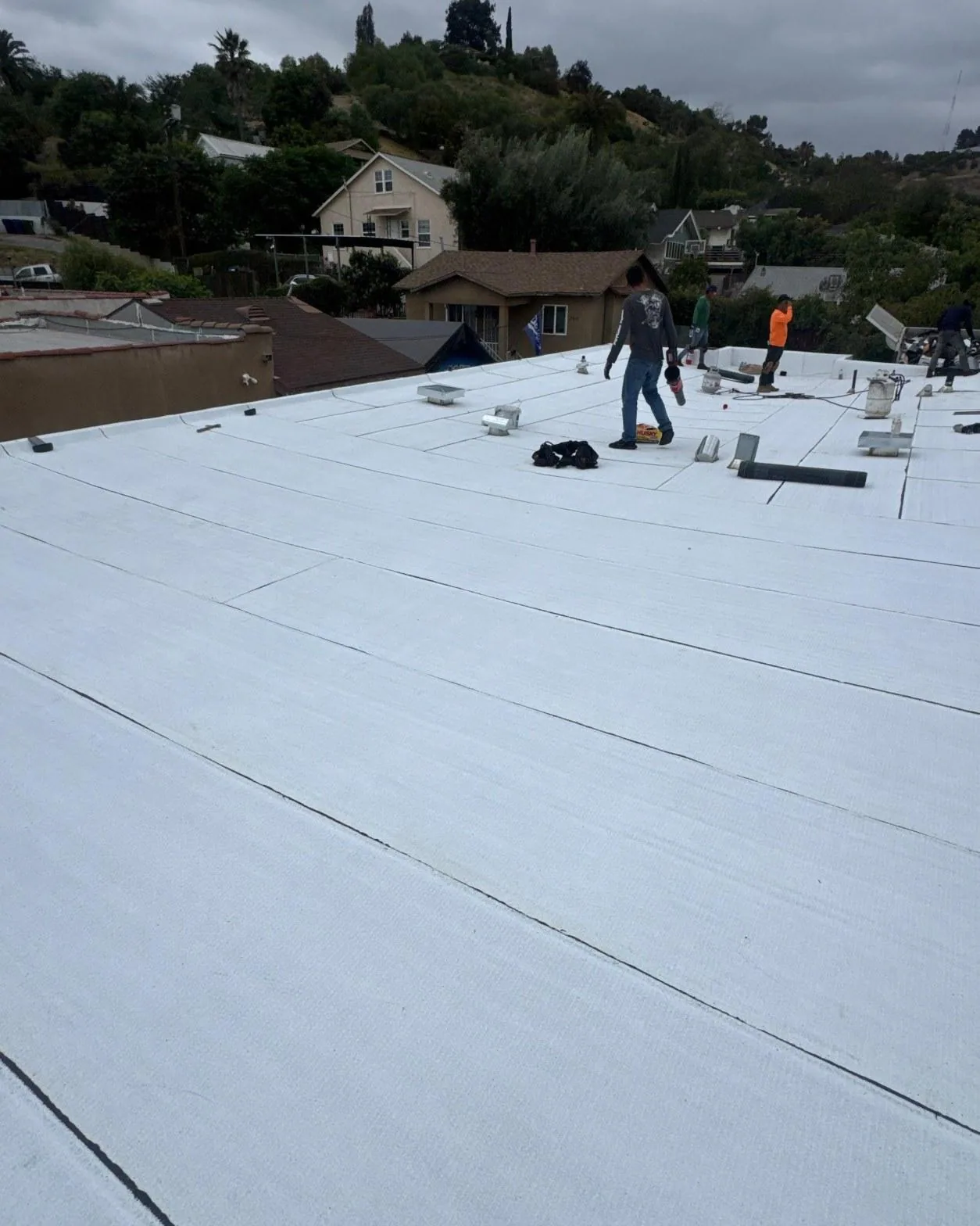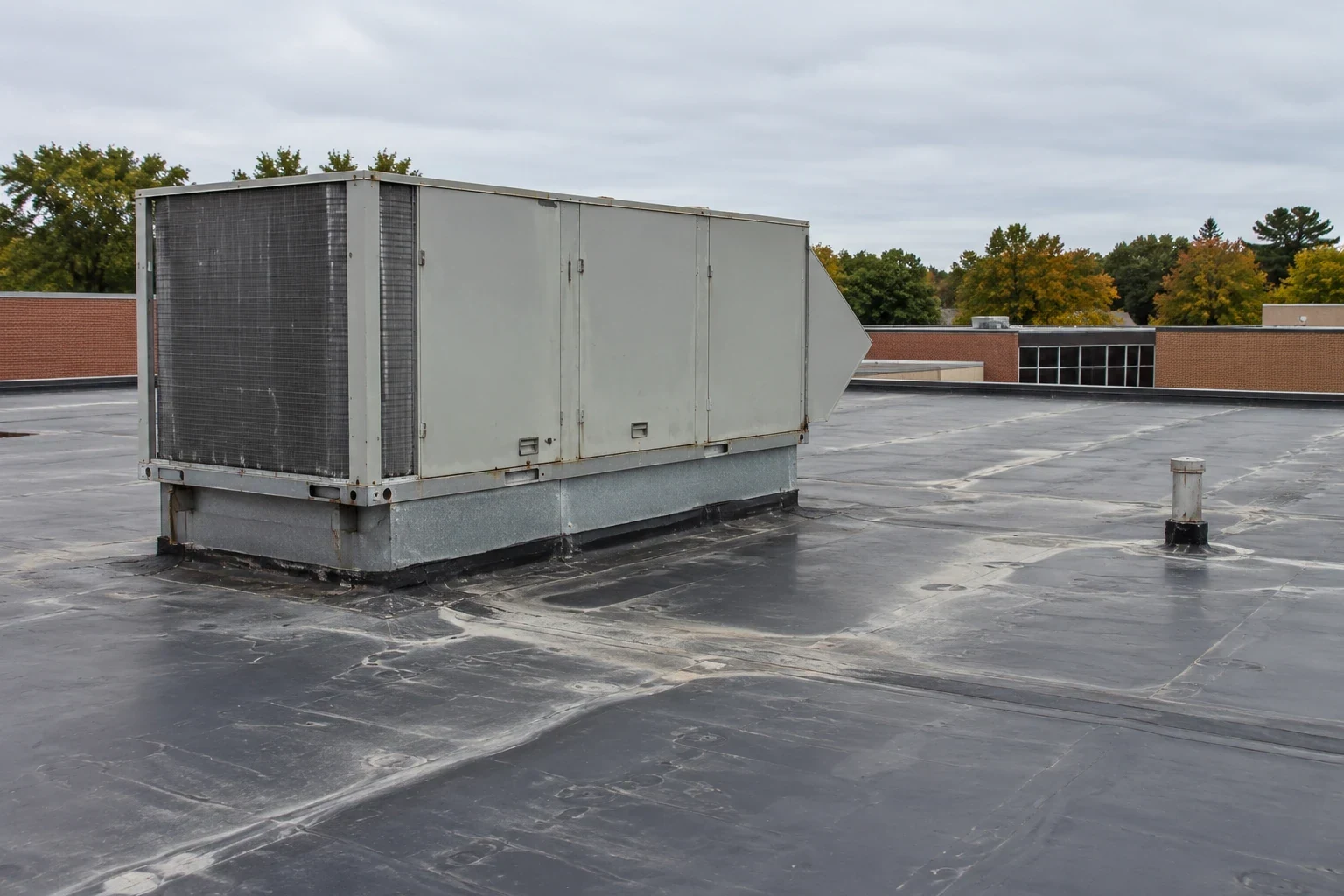
Repair commercial rooftop equipment curbs, rails, and pipe supports in Independence, MO by checking load transfer, flashing, movement, and drainage.
A rooftop unit transfers weight and vibration through its curb into the roof deck. The membrane must remain watertight where that load path crosses the roof surface. We inspect curb attachment, support framing, flashing, and the equipment connection before deciding whether a repair is local or structural. Independence, MO has commercial development at Eastgate and a 2025 commercial remodel at Centerpoint Medical Center. Local building activity does not establish the equipment or roof condition at another property.
Trace the Equipment Load
Start with the support, not the sealant. We check whether the curb bears on framing or deck, whether fasteners remain engaged, and whether movement has opened the flashing. A heavy unit on a curb with loose attachment can flex the roof transition each time a fan starts. Pipe supports can also shift when lines expand, contract, or vibrate.
We identify the equipment type and support arrangement, then look for deflection, crushed insulation, corroded metal, displaced rails, and movement at the curb corners. A roof walk should not treat every vibration as a membrane defect. We compare the reported symptom with the support condition and the roof assembly beneath it. If the deck is concealed, drawings, selective opening, or an engineer's review may be needed before changing the load path.
Eastgate Commerce Center has two new commercial buildings. New construction gives a useful local example of why curb height, equipment setting, and roof layers should be coordinated before installation. It does not tell us what is present on a different property. We verify the actual deck, insulation, membrane, and curb detail on the building under review.
When the curb is sound but the membrane flashing has split, a localized transition repair may be enough. When the curb has moved or the substrate is wet, sealing the visible seam can conceal a continuing load problem. A system-compatible roof repair should reconnect the flashing to sound material and leave the equipment supported as designed.
The Curb and Membrane Must Connect
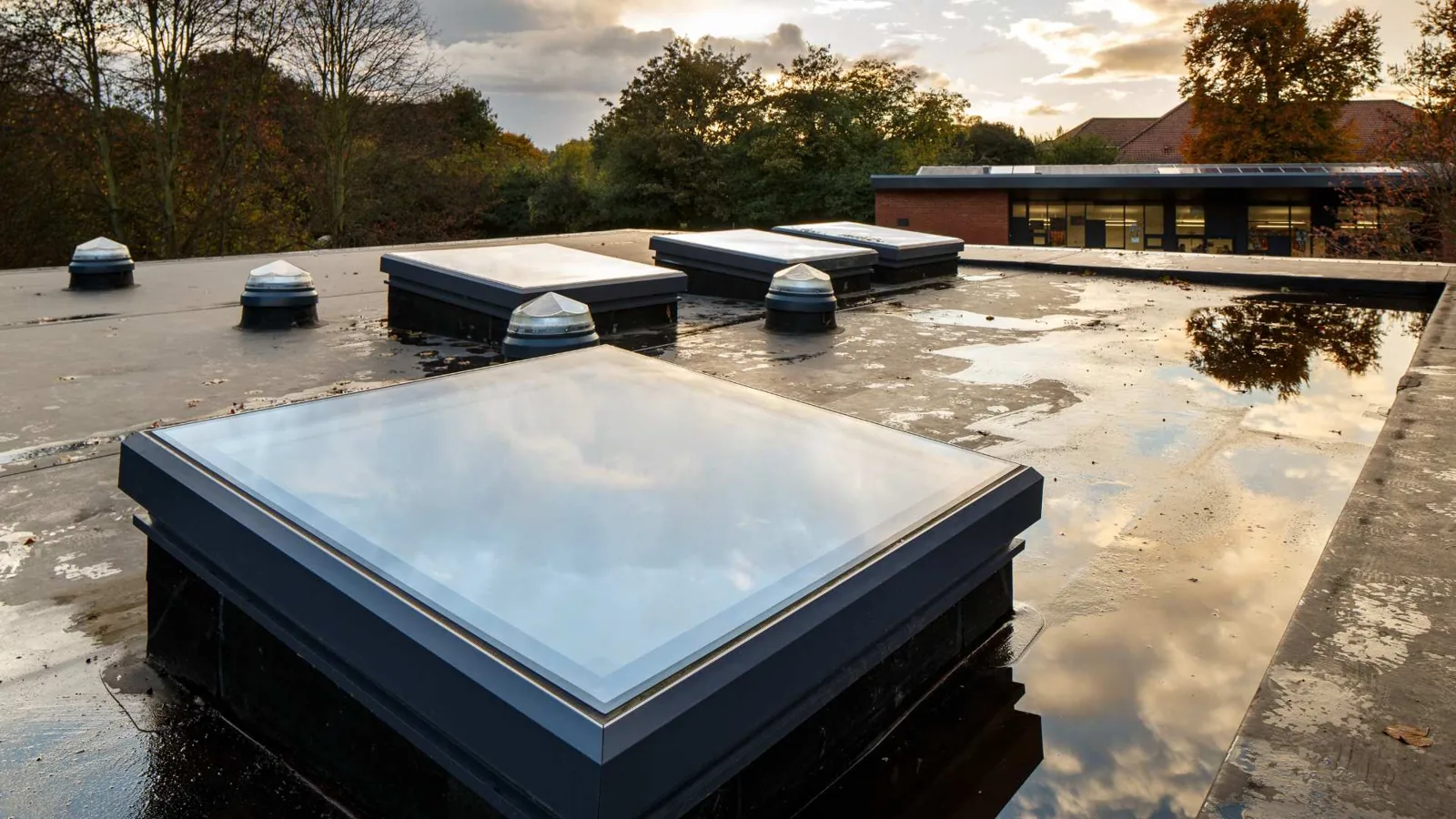
We inspect the curb height, corner geometry, fastening, counterflashing, and membrane termination. The flashing needs a continuous tie-in around the curb without fishmouths, unsupported laps, exposed fasteners, or sharp edges. Metal curbs can move at joints. Wood nailers can loosen or absorb moisture. The repair method depends on the curb material and the roof membrane, not on a generic bead of mastic.
Changes to equipment can leave abandoned openings, mismatched curb sizes, or new penetrations beside the original unit. We document what remains active and what needs closure. A new unit may sit on a different footprint, so the roof work must cover the old curb transition and detail the new one. Penetration flashing follows the same need for material compatibility, though the curb and equipment loads require their own detail.
Drainage around a curb deserves a separate check. Water can collect against its uphill side or enter through an open corner. A cricket may be needed where the curb interrupts the slope, but its placement must send water to a functioning outlet. We do not add a saddle that creates a second low spot. Drain and scupper inspection can establish whether the outlet or roof geometry is part of the same condition.
The top of the curb also matters. We check the equipment attachment, vibration isolation, and any gap between the unit and curb cap. Roofers should not alter a mechanical connection without the mechanical contractor's direction. We coordinate scope boundaries so roofing work restores the water barrier while the equipment team handles its system.
Movement Concentrates at Supports
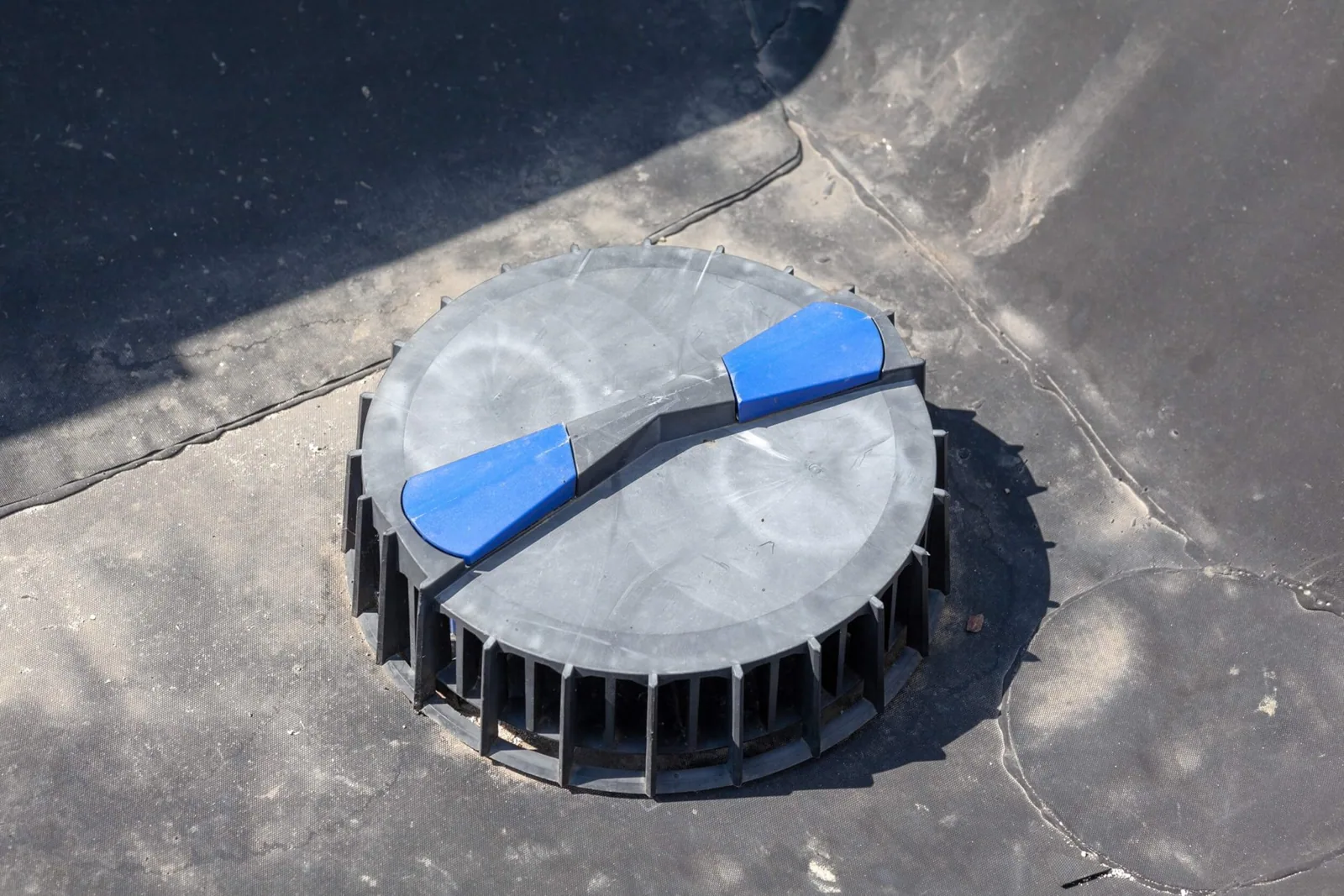
Thermal movement and vibration act at different interfaces. A pipe guide may need to restrain lateral movement while allowing line expansion. A rooftop rail can distribute equipment weight, but its supports still need compatible pads or flashings at each penetration. We inspect for compressed support blocks, loose clamps, rust staining, and membrane wear where a pipe or rail touches the roof.
Independence sits in a climate with substantial seasonal temperature change. Kansas City station normals place January lows near 20 degrees and typical July highs near 89. Metal, piping, sealants, and membranes do not expand at the same rate. A rigid detail can tear when a line moves. We look for a separation joint or support arrangement that accommodates movement without transferring it into the membrane.
Equipment operation can also affect repair timing. A property contact may need to schedule a shutdown, identify a safe access route, or confirm whether a unit can remain in service during the work. Near retail properties such as Liberty, Missouri, staging and pedestrian routes require coordination with site operations. That planning does not change the curb design; it determines how the repair reaches the detail without disrupting work below.
After severe weather, we check whether equipment screens, rails, and support points shifted, then inspect the membrane around them. Wind damage was reported north-northwest of Independence during the June 8, 2022 Jackson County tornado event. That report is tied to its recorded location. A roof assessment still documents the conditions found at the property rather than assigning damage from regional history.
Set a Repair Boundary
A repair scope may include replacing a split curb flashing, rebuilding a corner, resecuring a support, closing an abandoned penetration, or replacing wet insulation around a base. Larger movement or a damaged deck can require engineering and mechanical coordination. We identify which trade owns each connection and state where roofing work begins and ends.
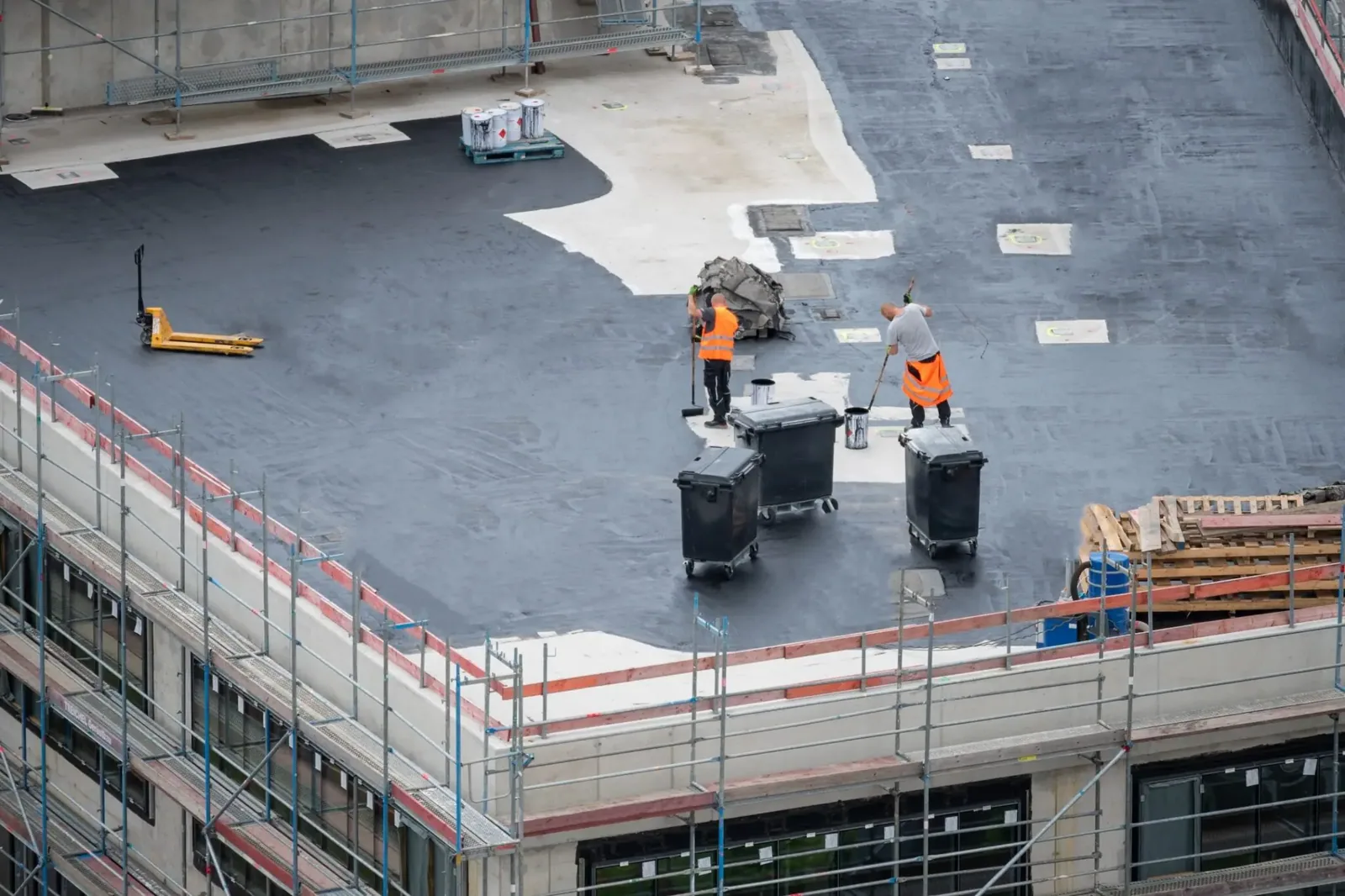
Access affects the sequence. Crews may need a lift, roof hatch, material route, or temporary protection inside the building. If work opens the membrane, the day's stop point needs a secure tie-in. A project near Buckner, Missouri may have installation-specific entry and work rules; those are confirmed through the facility's process rather than assumed from the place name.
Cost depends on curb count, dimensions, roof height, equipment weight, membrane type, substrate repair, access, and whether the mechanical unit must be lifted or disconnected. Reflashing one stable curb differs from correcting a support frame and replacing wet layers around several units. Photos and a roof plan help the owner see each location and understand which items are included.
For a larger asset list, a roof condition report can identify curbs, supports, and priority repairs by location. A maintenance program can then check fasteners, flashing, drainage, and vibration-related wear during scheduled visits.
Record the Support Detail
After repair, we inspect the perimeter flashing, curb corners, support attachment, and water route. The closeout record lists the equipment location, work performed, materials used, and any access or structural item that remains with another trade. That record helps the next service visit focus on the actual interface.
Arrange a rooftop support inspection with Commercial Roofing Independence. We will trace the load path, test the flashing transition, and define roofing work around the equipment's verified condition.
Commercial Roofing Questions
Does a leak beside an HVAC unit mean the curb failed?
The curb is one possible entry point. We inspect its corners and membrane tie-in, then check nearby seams, drains, and the equipment supports before assigning the source.
Can roofers repair a vibrating equipment support?
Roofing work can restore the support's flashing and attachment where that is within the approved scope. Mechanical vibration and equipment settings require coordination with the mechanical contractor.
What happens when a replacement unit is smaller than the old one?
The old opening needs a watertight closure and the new curb needs a compatible tie-in. We verify the dimensions and support before the unit is set.
Should the roof be opened around a loose curb?
A loose curb may require inspection of the substrate and fasteners before resealing. We document the movement and identify whether the deck or framing needs further review.
Can equipment supports be checked during maintenance?
Yes. Scheduled visits can note loose attachment, worn pads, open flashing, rust, and drainage at each support, with photos tied to its roof location.