Plan data-center roof work in Independence, MO with moisture paths, cooling equipment, assembly compatibility, and controlled access recorded before repairs.
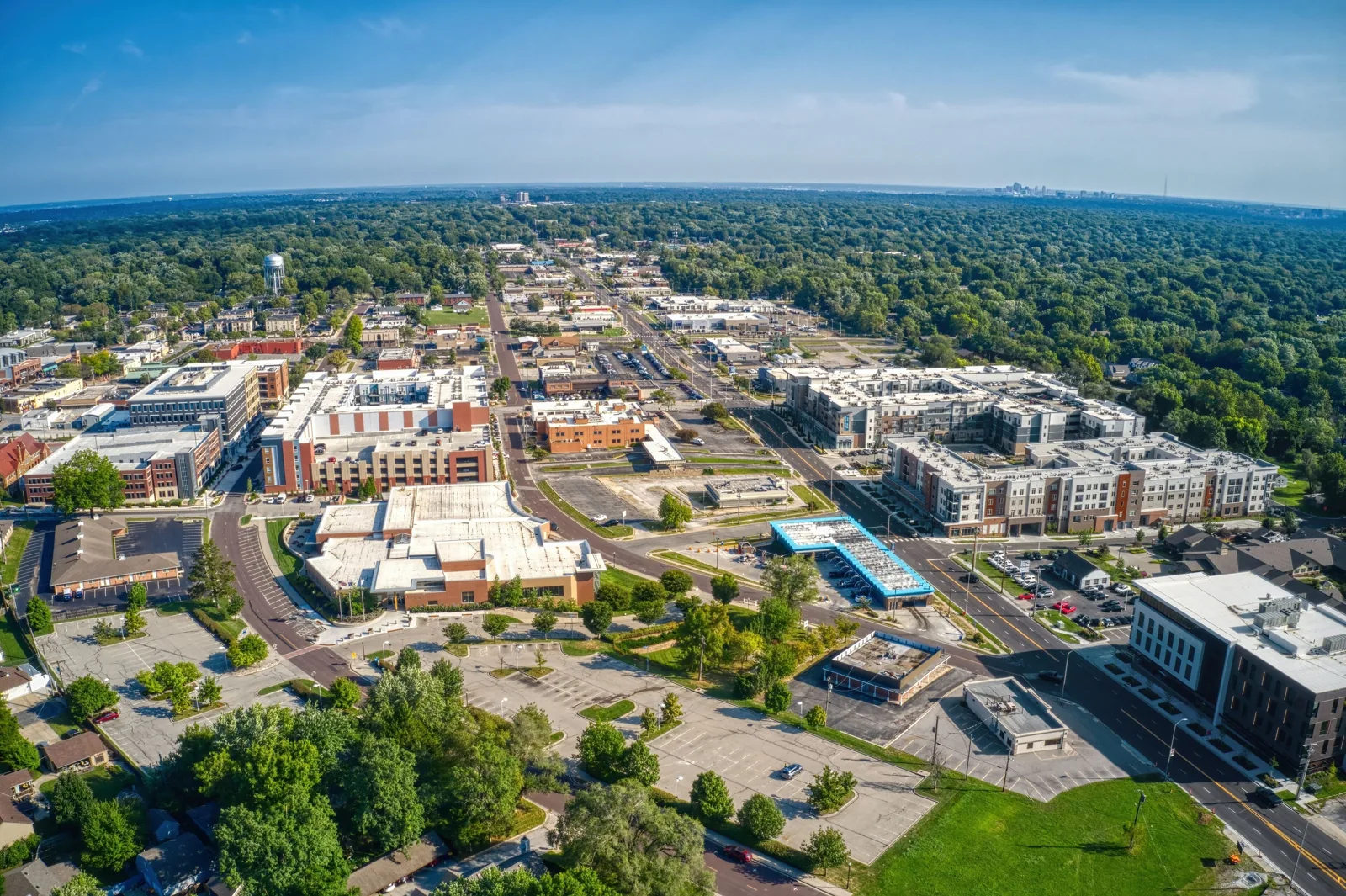
Data-center roofing is a moisture-control problem with strict consequences for the space below. Cooling equipment, electrical pathways, roof openings, and service routes concentrate detail work on an otherwise broad roof plane. Eastgate Commerce Center has two city-permitted commercial buildings along South Little Blue Parkway, and Independence also has major institutional facilities such as Grandview, Missouri. These facts describe the local commercial setting. They do not establish that either site is a data center or reveal its roof. We inspect the actual assembly and plan repairs around the owner's continuity requirements.
Dry Boundary Limits Water Risk
A small opening can matter more than a large area of worn membrane when sensitive equipment sits below it. We map water entry, locate roof penetrations, and note how a leak could travel through insulation or along the deck before becoming visible. A ceiling stain may be displaced from its source. Our review connects interior reports with seams, drains, curbs, and wall transitions, then marks where moisture was confirmed and where it remains uncertain.
We agree on how the facility will be protected before removing material. That can include interior containment, monitoring, temporary coverage, and a daily limit sized to the forecast and available crew. The building operator sets continuity controls. We define the roof work boundary and make the end-of-shift condition explicit. A repair should not leave a vulnerable interface beneath equipment access panels or cable supports.
Documentation also records roof access and equipment service clearances. A repair can be sound on the day it is installed and still fail if later service work cuts a new opening through the flashing. We leave the detail visible in the report so future maintenance can avoid that conflict.
Cooling Equipment Defines Roof Details
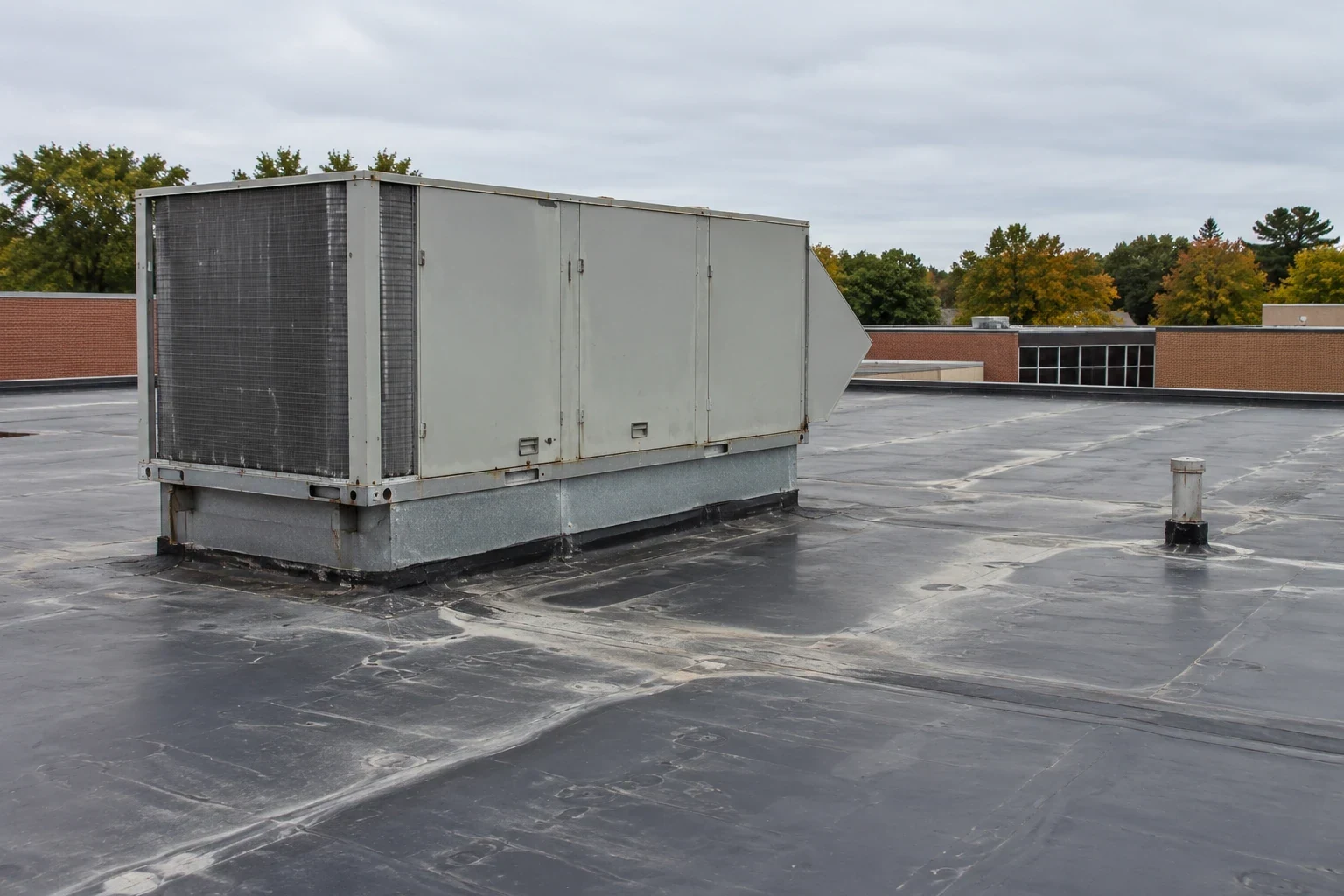
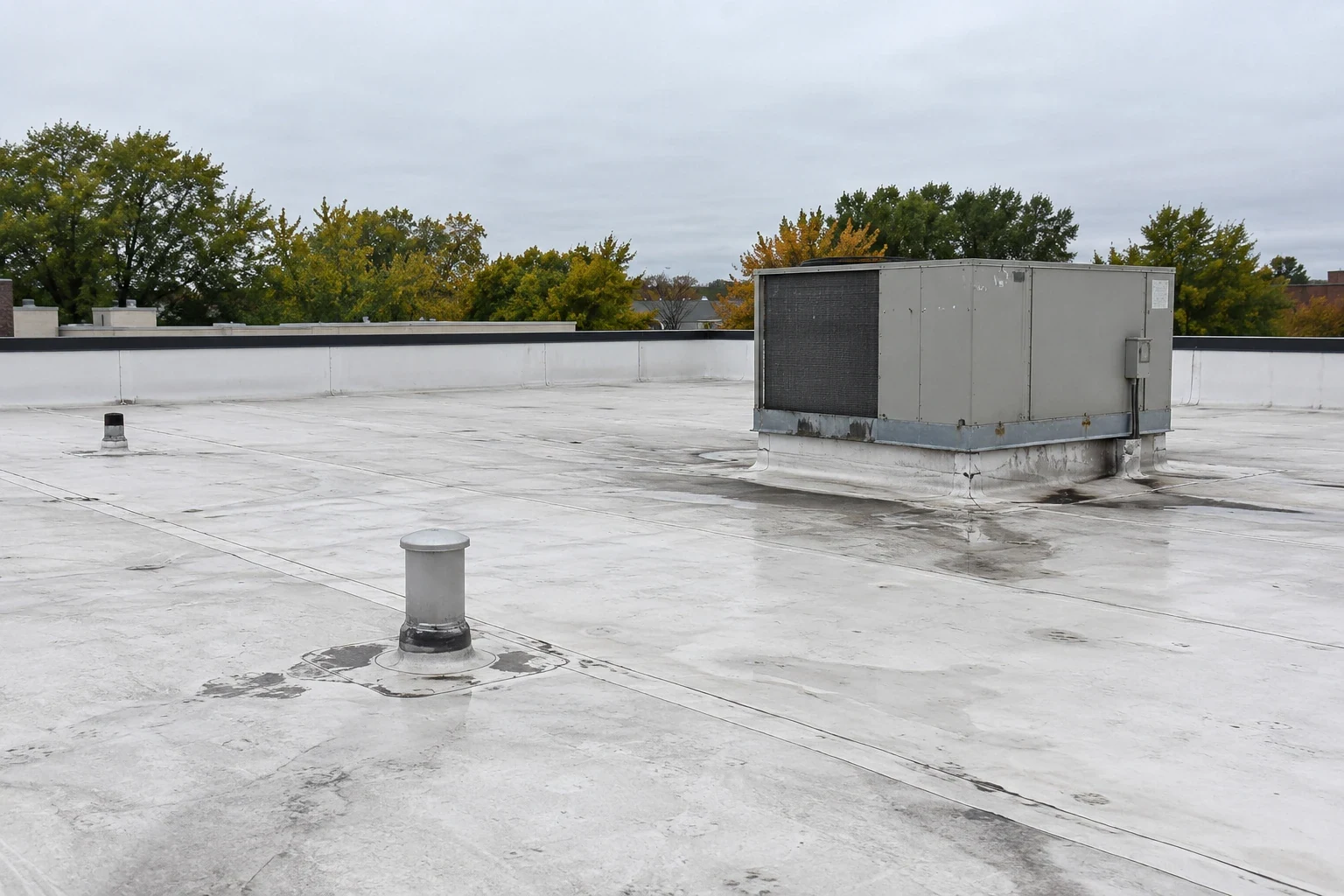
Cooling units create curbs, supports, piping, electrical connections, and service paths. We identify active equipment and preserve required access. Flashings are checked for loose edges, cracks, and movement where the curb meets the roof. Supports are checked for load transfer and membrane abrasion. If a unit must be lifted, its mechanical connections and reset responsibilities are coordinated before the roofing phase begins.
Drainage can be affected by equipment additions. A support or conduit placed in the wrong part of the roof can dam water or block maintenance access. We check the proposed layout against drains, crickets, expansion joints, and existing seams. If a new opening is required, the curb detail needs a sound substrate, compatible flashing, and a clear discharge route. Equipment-curb and support work is scoped with the mechanical design, not improvised after the membrane is cut.
Assembly Evidence Sets Scope
The first decision is what the existing roof is made of and how it is attached. We inspect the membrane or panels, cover board, insulation, vapor-control layers, and deck. Selective cores help verify layer count, moisture, and substrate condition. A recover may be viable over a dry, stable assembly. Wet insulation, loose attachment, or deck deterioration can require removal. The choice follows those findings and the project requirements.
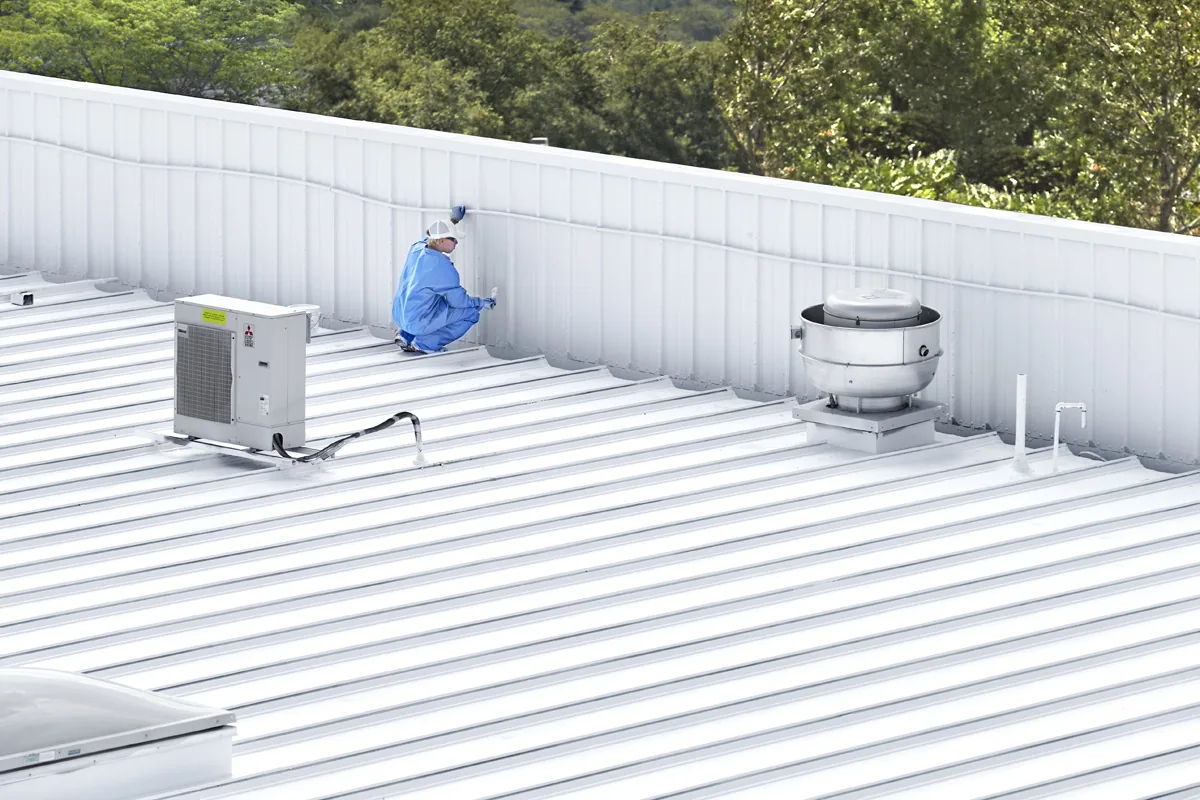
Different systems need different repair materials. We identify the surface before making a compatibility recommendation, especially where prior coatings or patches are present. A KEE membrane, a silicone coating, and a metal roof do not share one universal repair detail. We prepare a test area when adhesion is uncertain and record the observed result. The roof assembly determines the correct interface.
Local Exposure Tests Roof Interfaces
Cold mornings followed by hot roof-surface conditions can stress seals around cooling infrastructure. The Kansas City climate station recorded a normal January 1 low of 20 degrees and a normal July 20 high of 89. Those statistics belong to the metro station. We use them to frame inspection of moving penetrations and panel interfaces, then base the repair on the materials and adhesion found at the data-center property.
On June 8, 2022, an EF-2 tornado passed near Buckner in Jackson County, and the National Weather Service listed a wind-damage point northwest of Independence. The account does not identify damage at any data facility. We inspect the roof for actual displacement at curb corners, metal terminations, membrane seams, and equipment supports. Wind-damage documentation shows the observed locations and immediate stabilization needs.
Facility Limits Set Work Sequence
Data-center maintenance windows can be narrow. We organize access, material delivery, temporary protection, and daily closeout before work starts. The facility's representative identifies restricted areas, security procedures, and equipment that cannot be interrupted. We coordinate the roof scope with those instructions and record the limits of each phase. If hidden moisture or deck damage expands the repair, we secure the work and review the change before continuing.
Independence publishes 2024 IBC and existing-building requirements with its local amendments. The project's design lead confirms which provisions govern its roof alteration and attachment approach. We provide assembly records, photos, and clear notes on the attachment and flashing conditions. For a portfolio, condition reporting supports comparison between current defects and planned work. Related office roof reviews and manufacturing roof scopes still require building-specific findings. Schedule a review to identify the assembly, water path, and work boundary.
Once repair limits are agreed, we note which roof areas remain accessible for routine service and which details need follow-up. A roof plan should distinguish confirmed defects from conditions that are still being monitored. That separation helps the facility compare the immediate repair with future replacement timing and keeps maintenance inspections focused on the interfaces that carry the highest water risk.
Commercial Roofing Questions
Can roof work proceed without taking cooling equipment offline?
The sequence depends on the curb detail and the system's service constraints. We can phase around equipment that remains in operation when the roof can be opened, flashed, and closed safely. If a unit blocks the required detail or must be lifted, the facility and mechanical teams need to coordinate an approved window.
How do you limit the risk of water entering during replacement?
We set an opening limit the crew can close within the shift, check the weather, and protect the exposed assembly as work progresses. The facility team identifies interior zones needing added protection. If removal uncovers more moisture, we stop at a secure boundary and document the added condition.
Does infrared imaging confirm a roof leak?
No single image proves the source. Infrared patterns help direct inspection, while cores and visual checks establish what the layers contain. We compare those findings with leak reports, drains, and penetrations. The report distinguishes observed moisture from areas that need further testing.
What belongs in a data-center roof condition report?
The report should identify the assembly, deck and insulation observations, drainage, attachment, penetrations, and repair locations. Photos should show both the defect and its relation to equipment or roof zones. We also state which areas were sampled and what the evidence does not resolve. The report should show roof zones, system type where verified, active defects, drainage paths, penetrations, and any areas that could affect critical operations. It should distinguish observed conditions from items that need testing, and identify access limits that prevented inspection. For each recommended repair, record the location, material interface, and work sequence needed to keep water away from occupied or equipment areas. That gives facilities staff a practical basis for coordinating roof work with mechanical and security teams. Pair each photograph with a roof-zone identifier and a clear observation. A note such as “open lap at north curb” is more useful to facilities staff than a general label like “roof leak.”